Putrajaya
The city adjacent to Cyberjaya is Putrajaya, the administrative capital of Malaysia. When I first arrived in Cyberjaya and entered the area around the main square in Putrajaya, where the government offices are located, I was struck by the clean streets and well-organized buildings. I thought, “I didn’t know such a place existed in Malaysia.” I had initially assumed that Malaysia would be more dangerous and less developed than Korea. However, to my surprise, I found that many places were actually quite safe and well-organized with efficient systems in place.
Pink Mosjid (Putra mosque)
The Pink Mosque is said to be built over the Putrajaya Lake. To enter the mosque, visitors need to scan a QR code for the tour and receive a gown at the counter, which must be worn inside. There was a guide at the QR code scanning station. Once we put on the gown, the guide will walk with us and introduce us to the inside of the mosque. Women are required to wear the gown and headscarf to cover their hair, while men only wear the gown if they are in shorts. The mosque is built with four floors, and the third floor is the one connected to the ground level.
The third floor of the mosque serves as the prayer area, where professors also give speeches. At the back, there are well-equipped broadcasting facilities. The space is divided in half: the front is for the men to pray, while the back half is designated for the women. The remaining back portion of the space is dedicated to information posters for tourists, allowing them to view the prayer area from that side. I felt that the women’s prayer space was quite small, but the guide then led me to the fourth floor, explaining that it is a space exclusively for women to pray.
Inside the building, there were various patterns, most of which featured flowers and plants. The architect, when designing the structure, wanted to express the idea of fusion by traveling to many countries and incorporating different architectural styles from those places into the building. Stained glass was used on the windows, adding to the beauty. Inside, there were structures that utilized a honeycomb design. The architect explained that bees, when collecting nectar from flowers, do so without causing harm to the flowers. This concept was adopted with the hope that, like the bees, we could gain benefits without causing harm to others.
In the area where tourists were allowed to enter, there were several informational posters, including guidelines about what kinds of poses were inappropriate. The guide showed us a Korean-translated version of the Quran and explained the meaning of the writings on the mosque’s interior walls. I thought that the Bible, Quran, and Buddhist scriptures are similar in that they all convey values we should strive for. Although the religions are different, the messages they aim to share don’t seem to differ. The issue seems to arise from how we interpret and use those teachings. Ultimately, it seems to depend on the individual.
The second floor was designated for washing hands and feet. Everyone washes up there before heading up to the prayer room. The guide explained that this cleansing process is part of preparing oneself with a devout mindset. The first floor housed a library with over 5,000 books, including some in Korean. They also host various events, and the guide encouraged us to participate if we had the opportunity.
The guide also mentioned that during Ramadan, they offer free meals in the evening, and if we apply, we could be invited to join. As we stepped outside and looked at the square, the explanation continued. The reason the minaret is so tall is that, in the past, they would climb to the top to announce prayer times so that more people could hear and come to pray. Today, with modern broadcasting equipment, this is no longer necessary. In the square, trees were planted at intervals, and these trees symbolized resting places for the horses of the worshippers who would come to drink water. The Pink Mosque, being relatively new, had this symbolic feature integrated into its design.
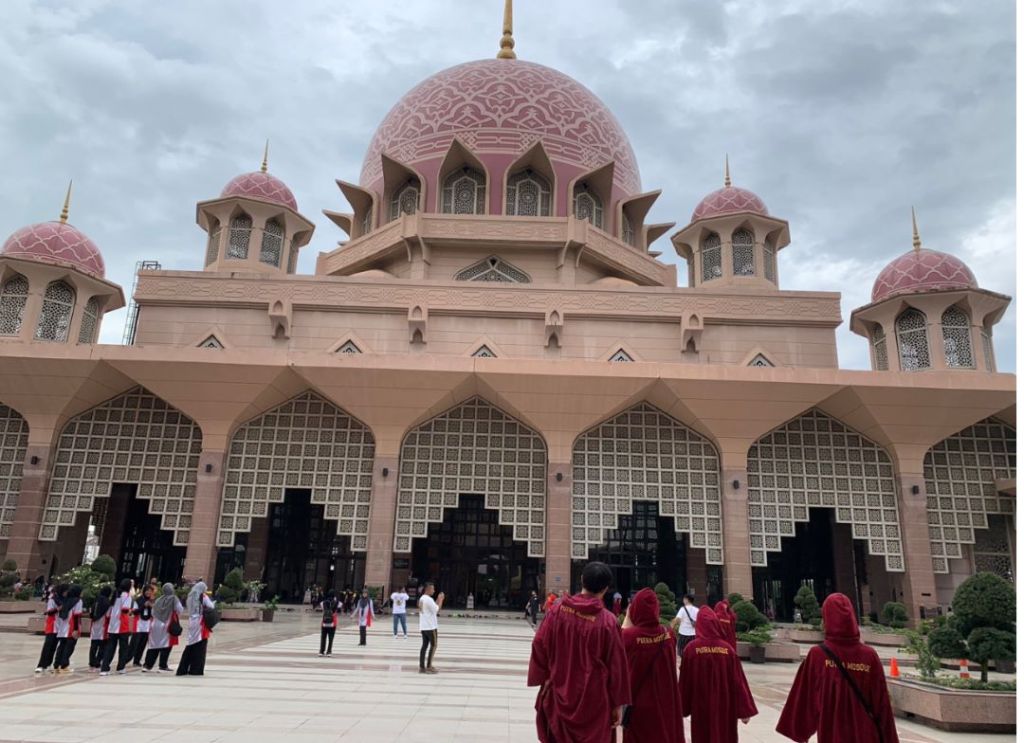
[Pink Mosque]
As you exit the Pink Mosque, you can see the green-roofed Prime Minister’s office in the distance. Right in front of it is a large square called Putra Dataran, where many people gather in the evenings to enjoy picnics. I once spent time with an Afghan friend at the square, playing with our kids, and during prayer time, we briefly followed and entered to pray. My friend, without hesitation, wore a white prayer robe, different from the gowns worn by tourists, and we sat together in the prayer room. The prayer time wasn’t as long as I expected. I became curious about what kind of prayer was performed during that short time.
That night, after 10 PM, we went out for dinner together. We returned to Cyberjaya and went to a Middle Eastern restaurant called Aldar Lounge, which was nearly full despite the late hour. My Afghan friend said it was a place they frequently visited. Even though I had been in Malaysia for a few years, this was my first time eating out so late at night. Usually, I cooked dinner at home with the kids, or if we ate out, we were back home before 10 PM because my second child was still young. But here I was, starting dinner at 10 PM… and it was my first time at an Arab restaurant as well.
I couldn’t tell the difference between all the kebab-like dishes, so I let my friend order for us. They ordered a variety of dishes. What caught my eye the most was a dish where the naan was used to cover a clay pot, with salt placed at the bottom and fire lit underneath. Inside the pot, there was grilled beef, chicken, and vegetables. The skewers of beef, chicken, and vegetables were grilled and served in a unique plating style.
Putrajaya Lake Cruise
Putrajaya is an island-like area surrounded by an artificial lake. There are 8 bridges connecting it to the mainland. When taking a cruise, you pass under several of these bridges. As we circled halfway along the river, we received explanations about the buildings along the riverbank. One of the highlights was a mosque made of 70% steel. Despite the metal structure, the space was designed so efficiently that it didn’t feel hot, as there was no air conditioning system inside. The mosque was called the Iron Mosque. We also saw the Millennium Monument before turning back.
The cruise lasted about 30 minutes. When booking the tickets, Malaysian residents could get a discount by showing their passport, and even students or guardians with a visa were given the discount. However, it seemed to depend on the staff—sometimes they said the discount was only available with a Malaysian ID card (MyKad), while other times they applied the discount without any issues. It varied depending on who was handling the transaction, so it was best to inquire before making a reservation. If the discount was granted, it was a nice bonus; if not, there wasn’t much to be done. Recently, the area around the dock has been redeveloped, and there are now many clean and modern restaurants forming a dining area.
Ayer 8
A friend living in Putrajaya recommended a delicious Vietnamese restaurant, so I went to Ayer 8. It seemed like a place only locals knew about. Since there weren’t many good Vietnamese restaurants around Cyberjaya, I thought I’d visit this one often, located just 15 minutes away. The area had several restaurants, and it was situated by the Putrajaya Lake, offering great views. On the lower floor, there was an Indian restaurant called D’tandoor, which was also delicious. It was a nice spot to visit when friends came from Korea or when there was a larger group. This complex also had a shop called “Bubble” where you could rent electric cars, 3, 4, and 5-person bicycles, and bubble machines. There were small games like fishing games that were perfect for kids to play after dinner. Being along the riverbank, it was a great spot to enjoy the beautiful evening views when the lights came on.
 Education and Life in Malaysia and Korea
댓글 남기기